Standardization Of Modern Chess Rules (15th-16th Century)
Before the late Middle Ages, chess was a much slower game. The moves of certain pieces were more restricted, leading to longer and less dynamic game-play. The transformation of chess into its modern form happened mainly in Spain and Italy between the late 1400s and early 1500s. This period marked a crucial turning point, making the game more strategic and exciting.
KEY CHANGES IN RULES:
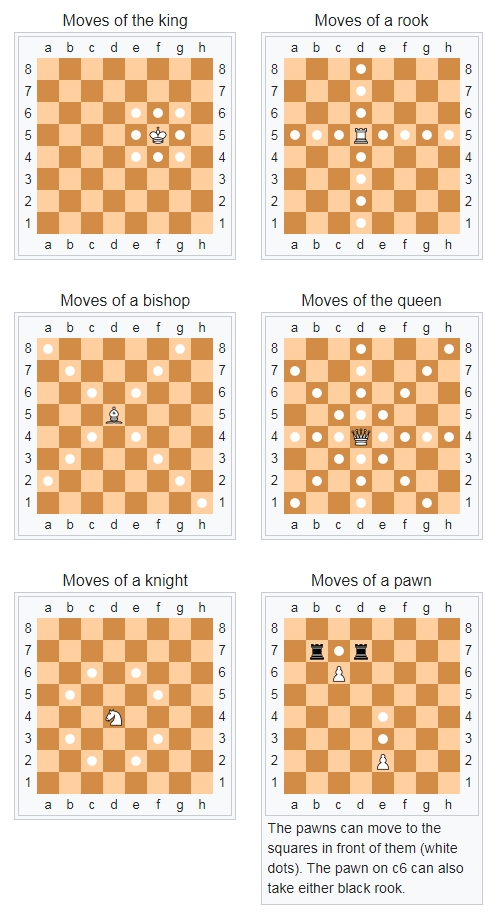
Queen’s Movement Becomes More Powerful (Late 15th Century)Originally, the queen could only move one square diagonally at a time.
Around 1475, it was given its modern long-range movement in all directions, making it the strongest piece on the board.
This change dramatically increased the speed and complexity of the game.
Bishop’s Movement is Extended In older versions of chess, the bishop could only jump two squares diagonally.
The new rule allowed it to move any number of squares diagonally, greatly increasing tactical possibilities.
Introduction of Castling (16th Century, Italy)Previously, the king had to move manually across the board to find safety.
Castling (a single move combining the king and rook) was introduced, improving king safety and accelerating development.
Pawn Promotion Rules Become More Flexible In earlier versions, pawn promotion was either limited or not present.
The new rule allowed pawns to promote into any piece (except a king) when reaching the eighth rank, making endgames more dynamic.
En Passant Rule (17th Century, France)Pawns could now move two squares forward on their first move, a change that sped up the opening phase.
To prevent abuse, the en passant rule was introduced, allowing an adjacent enemy pawn to capture it as if it had moved only one square.
IMPACT OF THESE CHANGES:
Chess became much faster and more tactical, leading to the birth of aggressive openings and combinations.
The first chess books and manuals (like Lucena’s "Repetición de Amores y Arte de Ajedrez" in 1497) started analyzing strategy based on the new rules.
Chess spread across Europe, with Spain and Italy leading the way in early theory and competitive play.
This transformation laid the groundwork for modern chess, making it the game we recognize today.
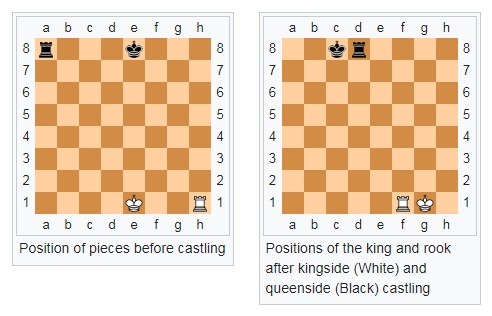
Castling consists of moving the king two squares towards a rook, then placing the rook on the other side of the king, adjacent to it. Castling is only permissible if all of the following conditions hold:
The king and rook involved in castling must not have previously moved;
There must be no pieces between the king and the rook;
The king may not currently be under attack, nor may the king pass through or end up in a square that is under attack by an enemy piece (though the rook is permitted to be under attack and to pass over an attacked square);
The castling rook must be on the same rank as the king
An unmoved king and an unmoved rook of the same color on the same rank are said to have castling rights.
En passant
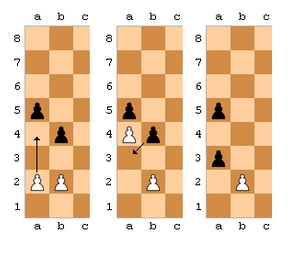
When a pawn advances two squares on its initial move and ends the turn adjacent to an enemy pawn on the same rank, it may be captured en passant by the enemy pawn as if it had moved only one square. This capture is legal only on the move immediately following the pawn's advance. The diagrams demonstrate an instance of this: if the white pawn moves from a2 to a4, the black pawn on b4 can capture it en passant, moving from b4 to a3, and the white pawn on a4 is removed from the board.
Promotion
If a player advances a pawn to its eighth rank, the pawn is then promoted (converted) to a queen, rook, bishop, or knight of the same color at the choice of the player (a queen is most common). The choice is not limited to previously captured pieces. Hence it is theoretically possible for a player to have up to nine queens or up to ten rooks, bishops, or knights if all of the player's pawns are promoted.
Check
A king is in check when it is under attack by at least one enemy piece. A piece unable to move because it would place its own king in check (it is pinned against its own king) may still deliver check to the opposing player.
It is illegal to make a move that places or leaves one's king in check. The possible ways to get out of check are:
Move the king to a square where it is not in check.
Capture the checking piece.
Interpose a piece between the king and the opponent's threatening piece (block the check).
End of the game - Checkmate
If a player's king is placed in check and there is no legal move that player can make to escape check, then the king is said to be checkmated, the game ends, and that player loses. Unlike the other pieces, the king is never captured.
Resigning
Either player may resign at any time, conceding the game to the opponent. To indicate resignation, the player may say "I resign". Tipping over the king also indicates resignation, but it should be distinguished from accidentally knocking the king over. Stopping both clocks is not an indication of resigning, since clocks can be stopped to call the arbiter. An offer of a handshake is sometimes used, but it could be mistaken for a draw offer.
Draws
The game ends in a draw if any of these conditions occur:
The player to move is not in check and has no legal move. This situation is called a stalemate. An example of such a position is shown in the adjacent diagram.
The game reaches a dead position.
Both players agree to a draw after one of the players makes such an offer.
Chess has a fascinating history that dates back more than 1500 years. It is believed to have originated in India, where it was known as "chaturanga" and was played in the 6th century AD. Through trade routes, the game spread throughout Persia, where it acquired the name "shatranj". From there, he was taken through the Islamic world to reaching Europe during the Middle Ages.
During the Renaissance, chess underwent a significant evolution in Europe, with the introduction of new rules and pieces, such as the modern queen and the ability to move pawns two squares on their first move. In the 19th century, chess became an international sport with the celebration of renowned tournaments, such as the 1851 London Tournament.
The 20th century saw the emergence of great champions, such as Emanuel Lasker, Jose Raúl Capablanca, Alexander Alekhine and, later, Bobby Fischer, Anatoly Karpov and Garry Kasparov. The rivalry between these players contributed to the boom of chess as a mentally challenging and exciting sport.
Today, chess remains one of the most popular and respected games worldwide, played by millions of people of all ages and nationalities. His rich history and strategic depth continue to inspire players and fans worldwide.
Chess960 (Bobby Fischer)
From: wikipedia.org
Chess960, also known as Fischer Random Chess, is a chess variant that randomizes the starting position of the pieces on the back rank. It was introduced by former world chess champion Bobby Fischer in 1996 to reduce the emphasis on opening preparation and to encourage creativity in play. Chess960 uses the same board and pieces as classical chess, but the starting position of the pieces on the players' home ranks is randomized, following certain rules. The random setup makes gaining an advantage through the memorization of openings unfeasible. Players instead must rely on their skill and creativity.
The concept of random chess, also known as shuffle chess, was first proposed by the Dutch chess enthusiast Philip Julius van Zuylen van Nijevelt (1743-1826). In his renowned treatise on chess, La Supériorité aux Échecs, published in 1792, Van Zuylen van Nijevelt articulated his disdain for the repetitive patterns often found in standard chess openings. This early conception of random chess by Van Zuylen van Nijevelt laid the foundation for Chess960.
Randomizing the main pieces had long been known as shuffle chess, but Fischer introduced new rules for the initial random setup, "preserving the dynamic nature of the game by retaining bishops of opposite colors for each player and the right to castle for both sides". The result is 960 unique possible starting positions.
In 2008, FIDE added Chess960 to an appendix of the Laws of Chess. The first world championship officially sanctioned by FIDE, the FIDE World Fischer Random Chess Championship 2019, brought additional prominence to the variant. It was won by Wesley So. In 2022, Hikaru Nakamura became the new champion.
The name "Chess960" (pronounced "Chess nine-sixty") was chosen to reflect the 960 possible starting positions in the game.
Fischer went on to say: “I love chess, and I didn't invent Fischerandom chess to destroy chess. I invented Fischerandom chess to keep chess going. Because I consider the old chess is dying, it really is dead. A lot of people come up with other rules of chess-type games, with 10×8 boards, new pieces, and all kinds of things. I'm really not interested in that. I want to keep the old chess flavor. I want to keep the old chess game. But just making a change so the starting positions are mixed, so it's not degenerated down to memorization and prearrangement like it is today.”— Radio Interview, June 27, 1999
Setup
Before the game, a starting position is randomly determined and set up, subject to certain requirements. White's pieces (not pawns) are placed randomly on the first rank, following two rules:
The bishops must be placed on opposite-color squares.
The king must be placed on a square between the rooks.
Anther Way to Create Initial Positions:
Place the eight white pieces in a bag. Draw them one by one and place them on squares a1, b1, ... h1.
If the bishops are on the same color, look at the following pairs: a1-b1, c1-d1, and e1-f1. Swap the leftmost pair that contains a bishop.
If the king is not between his rooks, swap the king with the closer rook.
Or:
Place all main pieces (black & white) in a bag. Draw them one by one and place them on squares a1, b1, ... h1.
If it's a black piece, place it on a square equal to the white pieces already there, otherwise start placing them on a8, b8, ... h8. And do likewise with the white. In this way you can't just feel which piece you are taking out, it just makes it a bit more random.
If the bishops are on the same color, look at the following pairs: a1-b1, c1-d1, and e1-f1. Swap the leftmost pair that contains a bishop.
If the king is not between his rooks, swap the king with the closer rook.
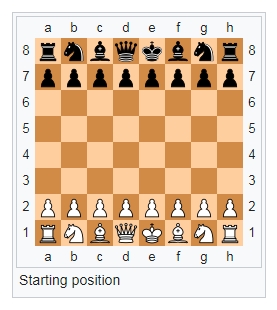
The end result is Black's pieces are placed equal-and-opposite to White's pieces. (For example, if the white king is randomly determined to start on f1, then the black king is placed on f8.) Pawns are placed on the players' second ranks as in classical chess.
The initial setup need not necessarily be random. The players or a tournament setting may decide on a specific position in advance.
After setup, the game is played the same as classical chess in all respects, with the exception of castling from the different possible starting positions for king and rooks.
Castling Rules
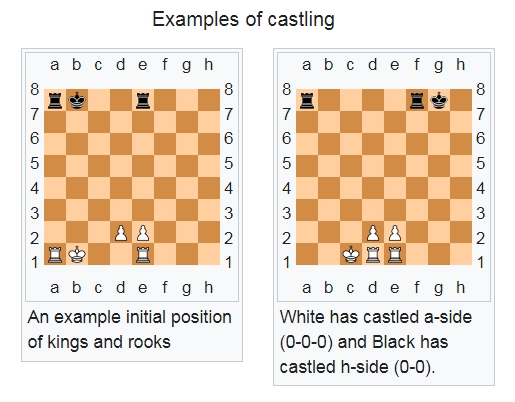
As in classical chess, each player may castle once per game, moving both the king and a rook in a single move; however, the castling rules were reinterpreted in Chess960 to support the different possible initial positions of king and rook. After castling, the final positions of king and rook are the same as in classical chess (ending on the same squares as if playing regular chess), namely:
After a-side castling (queenside/long castling in classical chess), the king finishes on the c-file and the a-side rook finishes on the d-file. The move is notated 0-0-0 as in classical chess.
After h-side castling (kingside/short castling in classical chess), the king finishes on the g-file and the h-side rook finishes on the f-file. The move is notated 0-0 as in classical chess.
Castling prerequisites are the same as in classical chess, namely:
The king and the castling rook must not have previously moved. Note that if the king did not move while castling on a previous move (i.e. the king is on c1 or c8 already while castling a-side or on g1 or g8 already while castling h-side), it may be possible for this condition to still hold for castling on the other side. However, the FIDE rules explicitly state that castling may be done only once per game per player.
No square from the king's initial square to its final square may be under attack by an enemy piece, even if the king is already on its final square.
All the squares between the king's initial and final squares (including the final square), and all the squares between the castling rook's initial and final squares (including the final square), must be vacant except for the king and castling rook.
If castling is allowed and a player decided to do it, the final positions of the king and the rook are the same as the ones reached during castling in a standard game. Thus, to castle in Chess960, you must be familiar with the castling positions of regular chess, King side or Queen side.
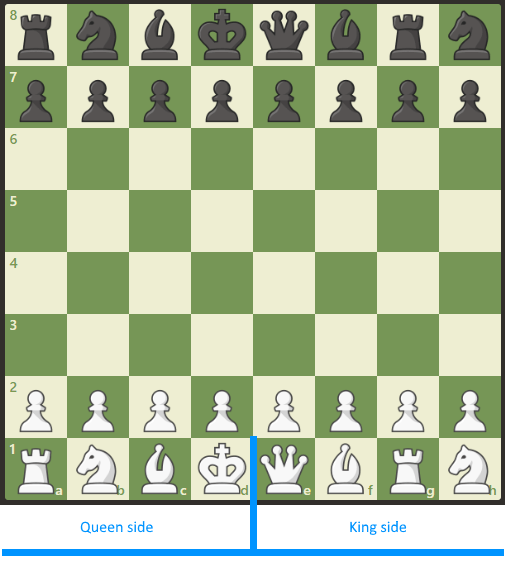
Notice in the diagram below the King is on the QUEEN side. Even though the king and queen can be positioned on different sides than in regular chess, the terminology for these regions of the board is still the same. The kingside is to the right of the white player, while the queenside is to their left.
An easy way to know which is which is to remember that in regular chess the Queen is always on it's own color. So in the diagram above d1 is where the Queen would normally start.
Since the king and rooks are placed randomly, the resulting move can look weird if you are not used to it. Sometimes the king and rook just switch places, sometimes only the king moves, and so on. Don't worry, though, since this is normal. The vital point to remember is that your king and rook always end in regular castle positions.
Also, a recommendation is to verbally announce the intent to castle before doing so.
Observations
It can happen that one of the king or rook does not move during the castling maneuver since it already occupies its destination square.
Another unusual possibility is for castling to be available as the first move of the game. The starting position had kings at f1/f8 and h-side rooks at g1/g8.
There are exactly 90 starting positions where, unlike in standard chess, players have to give up castling rights on one side
in order to castle on the other side. This is seen by calculating that this happens 18 times in each of five possible groups of
starting positions namely RKRxxxxx, RKxRxxxx, xRKRxxxx, xxxxxRKR and RxKRxxxx. In only these positions, a rook has to be moved (or captured)
on one side in order to castle on the other side. For example, in the starting position RKRBBNNQ, which is in the first group RKRxxxxx,
a player intending to castle a-side must first move the c-file rook (or let it be captured).
Theory
The study of openings in Chess960 is in its infancy, but fundamental opening principles still apply, including: protect the king, control the central squares (directly or indirectly), and develop rapidly, starting with the less valuable pieces.
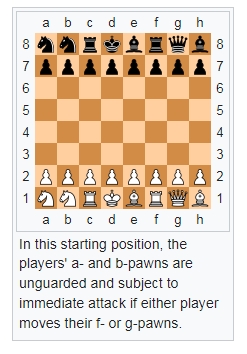
Unprotected pawns may also need to be dealt with quickly. Many starting positions have unprotected pawns, and some starting positions have up to two that can be attacked on the first move. For example, in some Chess960 starting positions (see diagram), White can attack an unprotected black pawn on the first move, whereas in classical chess it takes two moves for White to attack, and there are no unprotected pawns.
A Piece Of Advice
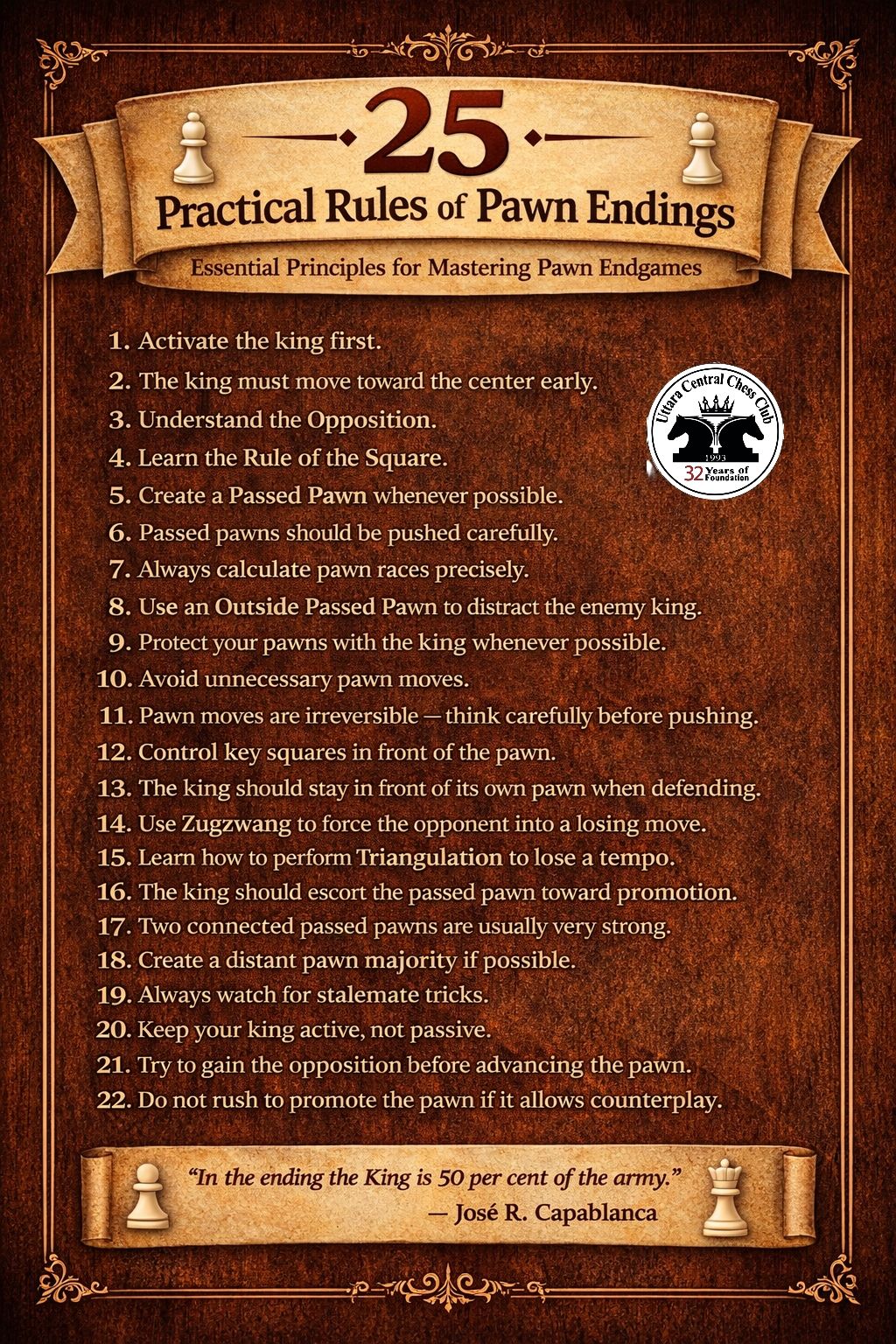
25 Practical Rules of Pawn Endings chess players should know
Pawn endings are extremely precise—one tempo can decide the game.
Activate the king first. In pawn endings, the king is the most powerful piece.
The king must move toward the center early.
Understand the Opposition. Opposition often decides who controls key squares.
Learn the Rule of the Square. It helps determine whether a king can catch a passed pawn.
Create a Passed Pawn whenever possible.
Passed pawns should be pushed carefully.
Always calculate pawn races precisely.
Use an Outside Passed Pawn to distract the enemy king.
Protect your pawns with the king whenever possible.
Avoid unnecessary pawn moves.
Pawn moves are irreversible—think carefully before pushing.
Control key squares in front of the pawn.
The king should stay in front of its own pawn when defending.
Use the Zugzwang to force the opponent into a losing move.
Learn how to perform Triangulation to lose a tempo.
The king should escort the passed pawn toward promotion.
Two connected passed pawns are usually very strong.
Create a distant pawn majority if possible.
Always watch for stalemate tricks.
Keep your king active, not passive.
Try to gain the opposition before advancing the pawn.
Do not rush to promote the pawn if it allows counterplay.
Central pawns are generally stronger than wing pawns.
Simplify to a pawn ending only if it is clearly winning.
Calculate every move carefully pawn endings leave no room for mistakes.